






The History of Online Casinos
Believe it or not, the history of online casinos includes Caribbean islands, cryptographic pioneers, legislative dramas, and technological leaps that transformed into what we know today. This is the story of how gambling found its way online.
The Origins of the Iraq game: Ancient Iraq (Mesopotamia)
The culture of playing board games and other games of chance began in Iraq, in Mesopotamia, which enjoyed the reputation of being the cradle of civilization. Just think! A board game called Royal Game of Ur, made between 4,600 and 2,600 BCE, was discovered, a beautifully crafted Iraq game offering a gateway to the past. According to various researchers, the board was ornately carved and used early dice for play, showing that ancient Iraqis were fond of games of skill and chance.
The Early 1990s
In the early 1990s, dial-up internet was the norm, and the World Wide Web was just being born. In the twin-island state of Antigua and Barbuda, in 1994, the landmark Free Trade & Processing Act law was a piece of economic foresight that issued licences to any firm interested in opening an online casino. Long before anyone else could have anticipated this, Antigua and Barbuda had themselves bet big on the potential of the internet. However, at that time, technology was still in its infancy; that changed.
Microgaming, a company based on the Isle of Man, was hard at work creating the first truly operational gaming software.in combination with CryptoLogic, which created encryption software to enable secure financial transactions. The combination of technology that could host games and technology that makes financial payment secure created an industry.
Mid to Late 1990s
You no longer had to go to Vegas or Monte Carlo. By the late 90s, casinos had come to your computer, leading to the rise of the best online casinos for Iraqi players that we see today. These early sites were very basic, simple, compared to today’s standard. Basic graphics, slow gameplay, and limited selection to blackjack, online roulette, and simple slots. Players often had to download the casino software directly to their desktop computer.
The growth of online gambling websites was fast. In 1996, there were only about 15 gambling websites, but by 1997, there were 200. Recognising the need for oversight, This early regulatory framework for online gambling added a layer of credibility to an industry that many still viewed with suspicion. By 1998, online gambling revenue exceeded $830 million. That same year, the first online poker rooms were introduced.
History of Online Casinos: The 2000s Era
The industry continued to mature, with more sophisticated software, better graphics, and a wider array of online gambling games. The estimated number of online gamblers ballooned to eight million by 2001.
Christopher Moneymaker (his actual full name) is an American poker player who won the Main Event at the 2003 World Series of Poker. His 2003 win is said to have revolutionized poker because he was the first person to become a world champion after qualifying at an online poker site. Turning an $86 online entry into a $2.5 million first-place prize
His name became the stuff of marketing legend. Suddenly, every amateur player with a computer and a dream believed they could be the next Moneymaker. This sparked the “poker boom,” flooding online poker rooms with millions of new players eager to test their skills.
The United Kingdom Gambling Commission was established in 2007 to provide a robust licensing framework. Players today can see the results of this evolution on platforms like Betfinal Casino, which offer safe and licensed environments.
Smartphone Revolution & Live Dealers: The 2010s
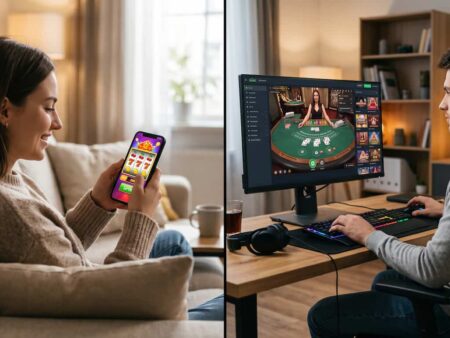
If the 2000s were about expansion and regulation, then the 2010s were about transformation and accessibility for Iraq betting enthusiasts and players worldwide. The catalyst for this seismic shift was the smartphone. With the advent of high-speed 4G networks and the proliferation of iPhones and Android devices, the online casino escaped the home office and followed the player everywhere. Commuting to work? You could spin the slots. Waiting in line for coffee? Place a bet on the football. The convenience was intoxicating. By the late 2010s, mobile gaming had become the dominant force, accounting for over half of all digital gambling revenue.
This era also delivered perhaps the most significant innovation in online casino history: live casino dealer games. For years, the one thing online casinos couldn’t replicate was the atmosphere of a real casino—the human interaction, the sight of a real card being dealt, the spin of a physical roulette wheel.
Live dealer technology bridged that gap. Using high-definition video streams, players could now connect with a real human dealer in a real casino studio. They could watch the action unfold in real-time, chat with the dealer, and even interact with other players. It was a revelation, offering the perfect blend of online convenience and land-based authenticity. You could be in your living room, but you were playing at a table in a studio in Riga or Malta.
A High-Tech Global Playground
Today, electronic gambling is a massive industry. The global market is now worth well over $90 billion annually. It has moved from the fringes of entertainment to the mainstream, with major sports teams sponsored by betting companies and television commercials becoming as common as ads for cars and soda.

The modern online casino is a marvel of technology and user experience, helping players effortlessly discover the best online gambling sites. It offers thousands of options for any Iraq game fan, from intricately themed video slots with cinematic storylines to virtual reality environments. In the modern era, knowing how to fund these accounts is vital, which is why players often consult guides to casino payment methods to find the most secure options. Today, leading global platforms provide modern avenues for the best online gambling to active Iraqi betting communities.
The security is bank-grade, with Random Number Generators (RNGs) regularly audited by third-party firms like eCOGRA to ensure fairness across all casino games. Cryptocurrencies like Bitcoin have also found a natural home, offering players anonymity and faster transactions. Personalization is key, with AI used to analyse player behaviour and offer tailored bonuses or game recommendations. It’s a far cry from the downloadable, basic software of the 1990s. From the 15 websites of 1996 to the thousands available today, the journey has been defined by constant reinvention. And if the past 25 years are anything to go by, the digital felt will only get more immersive, more innovative, and more intertwined with our digital lives for decades to come.