







RTP and the House Edge: How to Read the Numbers Before You Play?
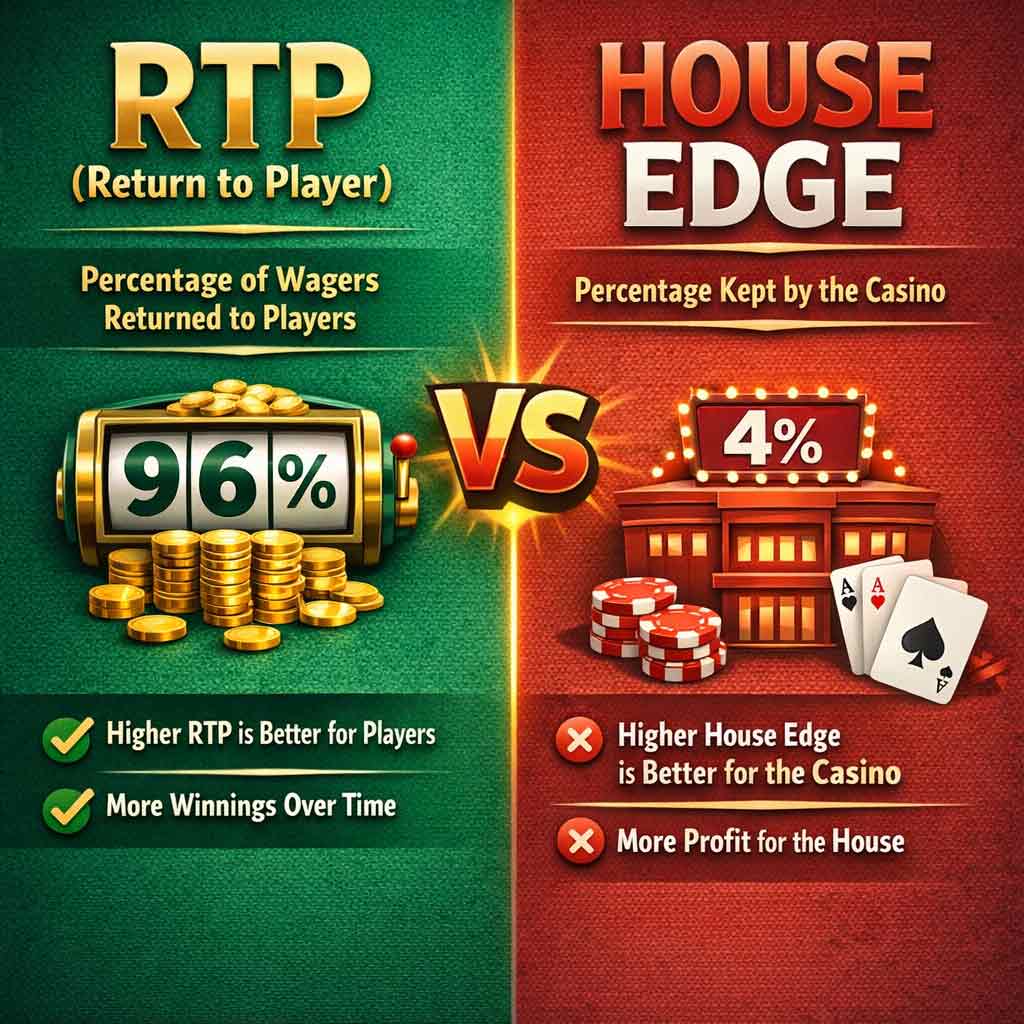
In online casino games, outcomes may seem to depend entirely on luck, but behind every game, there are numbers that tell you different things. The two most important figures here are RTP (Return to Player) and the House Edge. These numbers show the expected cost of playing when the same bet is repeated many times, and which games offer a better chance than others. In this article, we’ll explain what both terms mean in a simple way, the difference between them, and how to use them to compare games and choose what suits your style—without falling for common myths.
What Does RTP Actually Mean?
Most casino players misunderstand RTP (Return to Player) because it looks like a straightforward number, but in reality, it refers to a long-term mathematical average. In this section, we’ll explain the term in a simple way and why you shouldn’t link it to the outcome of a single session.
Explaining the Term
RTP is short for Return to Player. It is a percentage that indicates how much money a game is expected to return to players as winnings out of the total amount wagered—but only over the long run and across a very large number of rounds. In short, RTP is the expected average return over a very long period. Here’s an illustrative example:
- You’re playing slots and betting 10 Iraqi dinars per spin, and you play 100 spins.
- Total amount wagered = 10 × 100 = 1,000 IQD (this is called the total wagers, not your bankroll)
- If the game has RTP = 96%, that means in the long run: the average amount returned to players ≈ 96% of the total wagers
- 96% of 1,000 = 960 IQD, and the remaining ≈ 40 IQD is the average amount the casino keeps (which equals a House Edge of 4%).
But it’s very important to understand that this doesn’t mean that if you wager 100 IQD, you’ll get 96 IQD back. A single session can end with a big win or a big loss, because this average only becomes apparent over a very large number of rounds compared to the simplified example we’re using.
Randomness and Independence of Rounds
Players need to understand that each round is independent in its outcome. Seeing certain results now doesn’t force different results to appear in the next round, which means previous losses or wins do not change the odds of the upcoming round. For example, losing 10 times in a row doesn’t make a win “closer” or “due” on the next try. Likewise, if you just won, it doesn’t mean the game is now going to “punish” you. This belief is called the gambler’s fallacy, and it’s one of the main reasons people chase losses and misunderstand what RTP really means.
The Most Common Myths About RTP
- Myth 1: “An RTP of 96% means if I play 100, I’ll get 96 back.”
- Correction: (Return to Player) is a very long-term average; a short session can produce a completely different result.
- Myth 2: “After several losses, I must win in the next rounds.”
- Correction: Each round is independent; previous losses don’t increase your chances of winning next.
- Myth 3: “Since I just won, that means I’ll lose the next rounds.”
- Correction: A previous win doesn’t reduce your future chances; the game doesn’t depend on what happened before.
What Does the House Edge Mean?
Casino games are designed so that the casino has a small advantage in the long run. This edge isn’t a “fee” that’s deducted from you directly, and it isn’t a guaranteed outcome that repeats in every session. It’s simply an expected loss percentage that only becomes noticeable when you look at a very large number of rounds. Over time, if you add up all your results and compare them to the total amount you wagered across all rounds (i.e., the sum of your bets in every round), you’ll find that the average financial return tends to lean slightly in the casino’s favor.
In other words, you might win today, or you might lose, but over the long run, the house edge tells you what your average expected loss is over time in exchange for playing.
A Practical Definition of the House Edge
It can be defined using this formula: House Edge = (Average Loss ÷ Base Bet) × 100
More plainly: if the house edge is 2%, that means that in the long run, for every 100 Iraqi dinars in total wagers, you’re expected to lose on average about 2 dinars
- For example, if you bet 10 dinars per round and play 100 rounds:
- Total wagers = 1,000 dinars
- If the house edge is 2%, then the long-term expected loss is ≈ 20 dinars, keeping in mind that a single session can end up much higher or much lower than that because of randomness.
RTP and the House Edge: Two Sides of the Same Coin
When discussing a game’s fairness or its long-term cost, you’ll find that RTP and the house edge are the two most important indicators, because they describe almost the same idea—but in two different languages.
- Return to Player: expresses the share that is expected to be returned to players on average over a very large number of rounds.
- House Edge: expresses what the casino is expected to earn in the long run
For that reason, you don’t need to memorize both numbers—if you understand one of them, you can usually infer the other quickly. The key point is that these percentages relate to total wagers (the sum of what you bet across many rounds), not what happens in a single session. You may win or lose in the short term, but these figures reflect the long-term expectation. That’s why the relationship between them is usually direct and simple: House Edge ≈ 100% − RTP
- Example 1: If a game has RTP = 96%, then the house edge is usually about 4%.
- That means the long-term average points to an expected loss of roughly 4 out of every 100 in total wagers.
- Example 2: If a game has RTP = 92%, then the house edge is usually about 8%.
- This means the expected cost of playing is higher compared to a game with 96% RTP, even if the numbers may look close at first glance.
Why Do These Numbers Matter to Players?
(Return to Player) and the house edge might seem like theoretical percentages with no connection to what actually happens while you’re playing, but in reality, they’re among the most practical indicators for a player—because they help you make informed decisions instead of relying on gut feeling or luck alone. Of course, these numbers don’t predict the result of a single session. What they do is reveal the game’s long-term cost and give you an objective way to compare options before you start. You can boil that down into three clear, practical uses.
First: Comparing Games and Bets Objectively
The difference between a game with 96% RTP and another with 94% may look small, but it becomes meaningful when you repeat play over hundreds or thousands of rounds. That’s because the gap isn’t measured by what you wager once, but by what you wager many times. So when you’re comparing two games that are similar in fun and style, choosing the one with the higher RTP (or lower house edge) is the better mathematical choice in the long run.
Second: Estimating the Cost of Playing Instead of the Illusion of Profit
Many players fall into the mistaken idea that “if the percentage is high, then I will win.” In reality, a higher percentage only means the expected loss is lower over the long run. You can estimate it roughly like this: (Long-term expected loss ≈ Total Wagers × House Edge)
By total wagers, we mean the sum of what you bet across all rounds—not just your deposit balance. With this perspective, the numbers shift from misleading “promises” into a realistic estimation tool, allowing the player to calculate the average expected loss if they keep playing with a certain amount over time.
Third: Choosing a Game That Actually Fits the Player
Sometimes two games can have the same RTP—or values that are very close—yet the experience can feel completely different. The reason is what’s known as volatility (also called variance). Many players in the online casino iraq community aren’t familiar with it. So what exactly is volatility?
Volatility: refers to a game’s payout style—whether it tends to give small, frequent wins, or big wins that are rare. In other words, volatility doesn’t change the RTP, but it does determine how wins and losses show up during play. For example:
- High-volatility game: wins happen less often, but they can be large when they hit. It usually requires patience and the ability to handle longer losing streaks.
- Low-volatility game: offers smaller wins more frequently, which suits players who prefer a steadier feeling of “consistent” payouts.


